
Yellow Fever
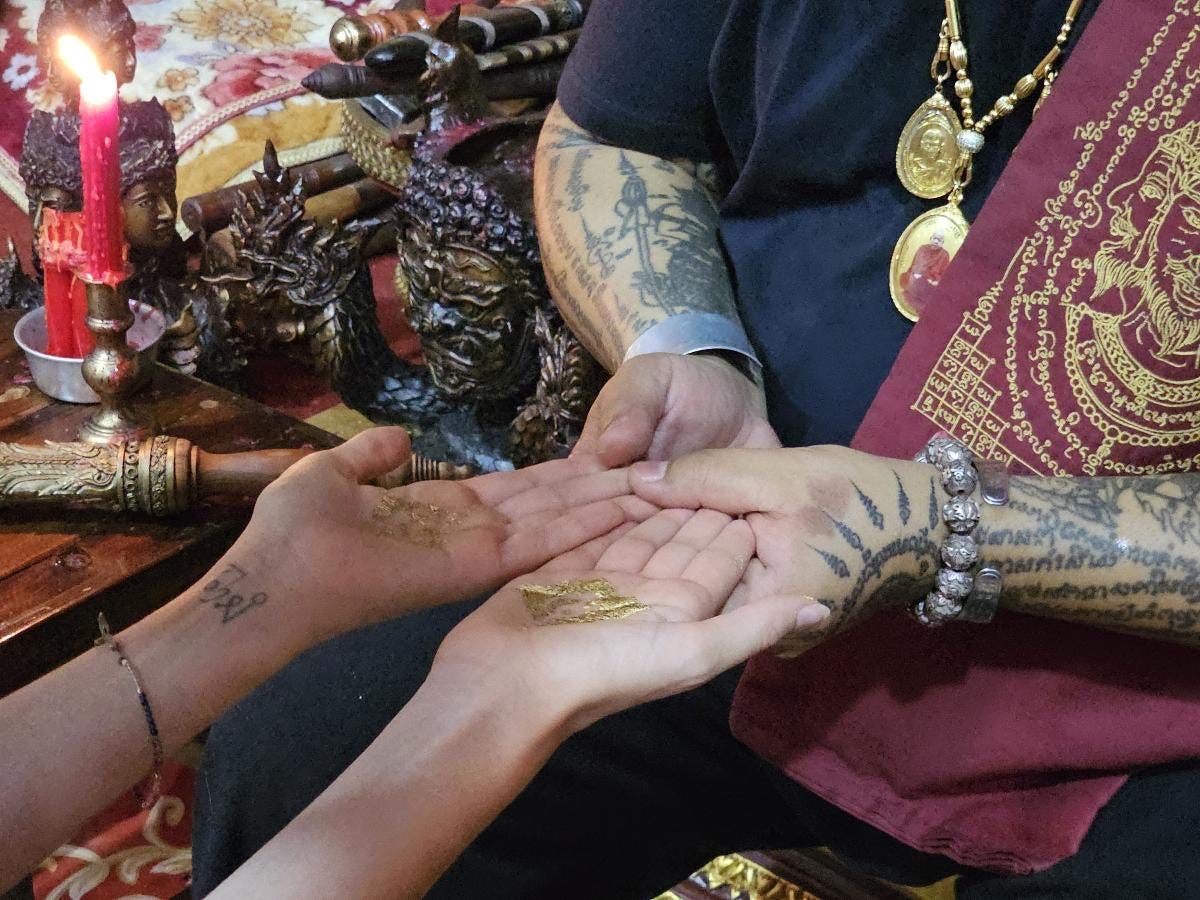
Ajarn P. chanted, his voice quick and steady, words rushing over themselves. He dipped his fingers in the yellow liquid, pressed them to my forehead, my hands, my throat.

The bike wore its history openly: a left mirror, cracked and clouded, hung loose from its casing, the tape binding it already slackening in the morning heat. At the shop on Nimmanhaemin, a boy drifted behind the counter, eyes sunk in the blue wash of his phone, fingers tracing my passport details, keys gliding across the battered counter with a sound muffled by the heavy air.
Five hundred baht.
I nudged the bike into the morning, the engine coughing once before finding its rhythm. I came to Chiang Mai in search of a story about fire. But the true reason for my journey was less direct, a pretext, simple and plausible enough to survive casual inquiry. Days earlier, I knelt on Ajarn P.’s tiles, the floor cool beneath my knees. Motorcycles howled and faded past the open window. The ceiling fan rattled, barely holding on. Deeper in the house, a television voice called out lottery numbers, drifting through incense haze and the sharp sting of something chemical. Ajarn P. moved quietly, collecting objects I couldn’t name: a plastic bottle with yellow liquid, incense sticks, a tray blackened by years.
People wandered in and out. A woman set fruit on a table. A mechanic leaned through the doorway, asked something, and disappeared. Phones rang and rang.
Ajarn P. chanted, his voice quick and steady, words rushing over themselves. He dipped his fingers in the yellow liquid, pressed them to my forehead, my hands, my throat. The atmosphere grew dense: smoke, crushed leaves, a sharp edge I couldn’t name.
He lifted a small cup and filled his mouth with alcohol. The gesture was simple, as ordinary as pouring tea.
He reached for a candle. The flame shivered, caught in the restless air the fan pushed around us.
First came heat, slow and thick, settling on my skin. It pressed close, a hidden ember. Orange light rested in the corners. Shadows trembled, then slipped away along the walls.
Then it was over. The room seemed to settle, folding quietly into its old shape, as if nothing had happened at all. The moment dissolved, leaving behind only the faintest trace, already fading into the hush of the house.
The television kept talking. The fan kept turning. Traffic continued passing outside.
The Ajarn nodded, the gesture as perfunctory as signing for a parcel.
Purification, someone said.
Of what, nobody knew.
All afternoon, I kept lifting my sleeve, searching for the faintest trace of smoke.
Days slipped by and I settled into a quiet routine. Ajarn P.’s house, hidden behind the constant drone of the highway, was less a sanctuary than a storeroom, realities stacked in precarious piles: monastic calendars with bent corners, engine-oil ads faded to ghosts, plastic amulets dangling from rusted nails. Lottery numbers drifted across the table, three phones blinked beside a bowl of offerings, the television muttering on, its blue light washing over walls and faces, never quite settling anywhere. Soap operas. Football matches. Advertisements. News reports. Music videos. The Singha heir scandal.
Each night, I sat in a shuttered room before a single candle. The instructions were simple: watch the flame and keep watching. Let nothing intrude.
The practice was an optical experiment. After a while, the flame slipped free from the candle. When I closed my eyes, it hovered in the dark, blue-white and vivid.
Outside, each afternoon, Chiang Mai dissolved into rain and rising steam, the streets turning over in puddles that mirrored the sky. Images surfaced everywhere: mirrors, reflections, photographs, icons, billboards, screens. Spirit houses stood before homes, miniature doubles of the buildings behind them. Tiny Buddhas nested inside larger temples, the city endlessly copying itself, each version tucked inside another, like nesting dolls.
And with the candle practice, the flame began following me. Even after I blew out the candle, its afterimage lingered behind my eyes. Moving through the city, fragments of that blue-white flame surfaced in the glare of headlights, in windows, in passing reflections. Its persistence outlasted its source, a presence more stubborn than the thing that made it.
I described this to Ajarn P.
He nodded.
“Good.”
“What is it?”
He shrugged.
His answer irritated me at first. Later, it made sense. What separates an afterimage from a ghost? Both linger after their source has vanished.
I once saw photographs of reactor workers moving through chambers flooded with Cherenkov light. Their bodies appeared as pale blue traces against white surfaces, as though presence itself could leave a stain.
I fear you are all blue pigments of bodies pressed against white walls now.
This is what the drift leaves behind. I no longer know you as a person. You remain as residue, a trace left by exposure. It can’t be helped. I exist to you in the same way.
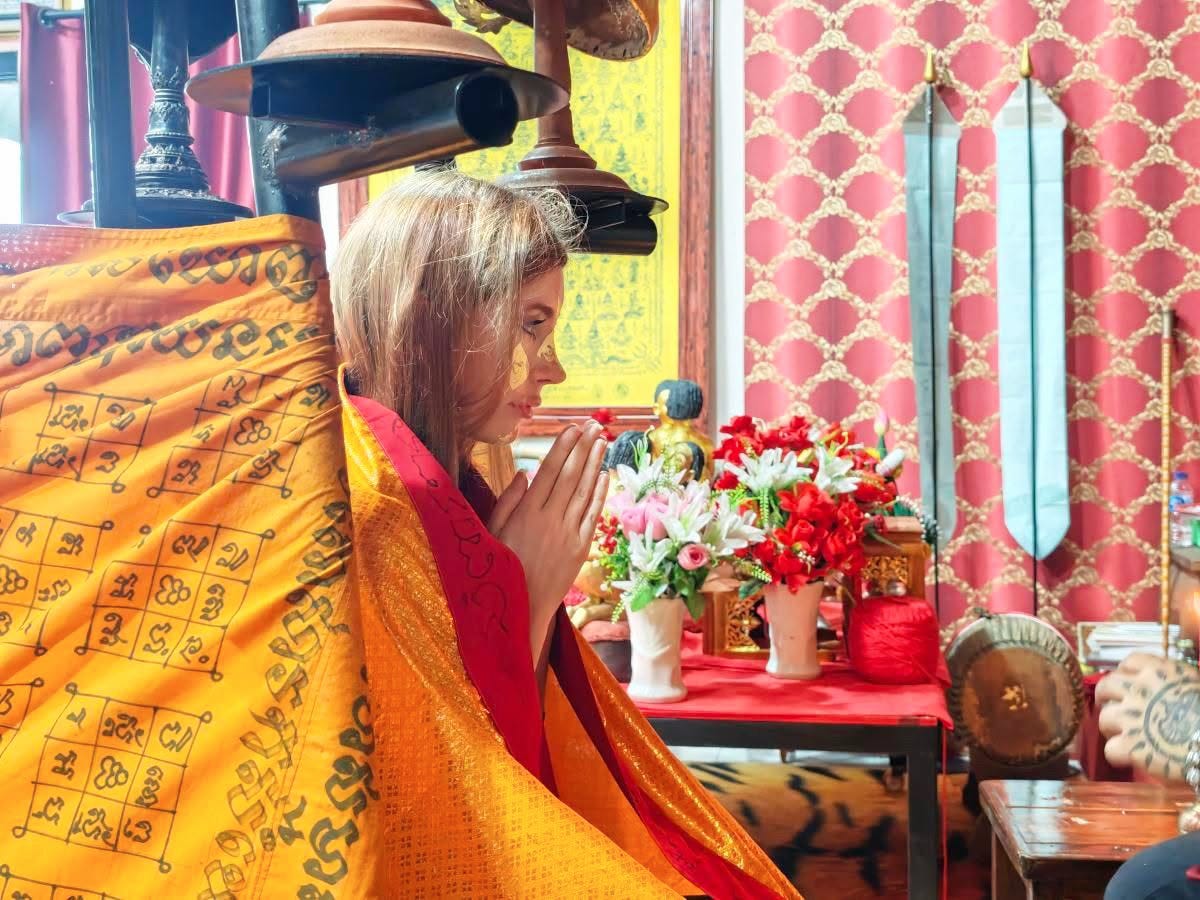
The following are unedited notes from conversations with Ajarn P. There are repetitions throughout. I hold deep respect for Thailand and its people, and approach this subject with cultural awareness. Ajarns frequently share their knowledge when engaged with thoughtful inquiry. This is an updated version of my Italian article on the theme; you can see it below.

Ajarn P. started learning about Thai magic as a child, growing up next to a temple crematorium in Nakhon Sawan. Like many children from economically disadvantaged backgrounds, he became a Dek Wat, or temple child, at an early age. In return for assisting with temple chores, he received meals, shelter, and education. Exposure to magic was constant, and he acquired kata by attentively listening to the temple’s daily chanting sessions.
Residence at the temple fostered Ajarn P.’s curiosity regarding amulets, which were commonly worn by community members. He observed that the inscriptions on these amulets were not in Thai, but rather in the ancient Khom script. His constant presence at the temple enabled him to inquire about these details. Some monks found it noteworthy that a child expressed interest in a script largely disregarded by adults.
Temple life proved rewarding, as numerous Ajarns visited and offered opportunities to learn through observation and participation. Ajarn P. demonstrated a strong interest in magic, acquiring knowledge primarily through experiential learning rather than formal instruction. The visiting Ajarns offered direct guidance on crafting amulets, applying Yant, and selecting appropriate kata for each stage of the process.
Over time, Ajarn P. became a supplier of ritual items to other Ajarns for use in empowerment practices. He produced these items, including hand-crafted Hoon Payon figures, which were subsequently completed by other Ajarns by adding Yant and takrut. Through deep immersion in magical practices, he acquired sufficient expertise in Yantra to begin performing Sak Yant at a young age. Buddhist teachings provided a moral framework, clarifying distinctions between ethical and unethical uses of magic and highlighting the continuum between its constructive and destructive forms. Although an Ajarn is traditionally expected to study both aspects, Ajarn P. intentionally chose to preserve and apply only the knowledge that serves to protect and benefit others.
Nevertheless, a comprehensive understanding of both black and white magic is essential. In cases involving curses, an Ajarn must be able to diagnose the issue and employ white magic to remedy it. White magic is associated with protection, wish fulfillment, and the bestowal of qualities such as metta, maha niyom, and sanaeh. It excludes the use of prai, which refers to human remains, and is identified as Puttakhun or Buddhist magic. In contrast, black magic involves the use of prai materials. The two forms are fundamentally distinct, analogous to the difference between generosity and criminal behavior.
But both types of magic need the same thing at their core: a strong mind and well-developed samathi. Without these, neither kind of magic works.
To cultivate samathi and mental strength, individuals must quiet their thoughts and concentrate fully on Buddhist teachings and the Buddha. An alternative method involves sustained focus on a candle flame, though this technique requires supervision by an experienced teacher. Body-part meditation is similarly demanding and should only be practiced under guidance. Observance of the precepts is essential, not because it directly enhances magical ability, but because it refines character and fortifies the practitioner’s resolve, thereby generating the personal merit foundational to these practices.
Thai white magic is distinct in that it does not involve ghosts or utilize any part of the human body as a source of power, whereas black magic incorporates both elements.
White magic is produced using Wahn, or magical plants, and sacred materials such as ancient Buddha amulets, which are ground and incorporated into the mixture. Many of these talismans are recovered from burial sites within temple grounds and are regarded as both sacred and powerful, having absorbed the earth element over extended periods. White magic is also referred to as Puttakhun. Its practice adheres to the principles of Puttasart Wicha. White and black magic are considered equally effective, and both can produce qualities such as sanaeh and metta. However, white magic cannot be used to harm others or to exert control over individuals through desire or emotional manipulation. Each tradition is honored with its own distinct form of offering. Any amulet containing prai, or ghost material, is classified within the broad category of black magic. This classification does not inherently indicate harm; rather, it signifies that the magic operates through a spirit, which is propitiated with offerings such as food, alcohol, and cigarettes. In contrast, Puttakhun offerings consist of water, flowers, and incense, reflecting Buddhist values. Most shrines incorporate elements of both traditions.
Misconceptions about black and white magic are prevalent in Thailand, particularly when people ask whether a specific Kuman Thong (an effigy, amulet, or statue of a child believed to be inhabited by the spirit of a deceased child) is classified as black or white magic. Kuman Thong is its own category of magic. While ghost materials may be incorporated to enhance their power, this inclusion alone does not define the practice as black magic. Black magic, in its proper context, refers to magic intended to cause harm or deliberately inflict damage upon another person. Most amulets and statues do not fall into either category; rather, they are considered. Another widespread misconception is that attraction magic, which draws individuals toward someone, is necessarily black magic. In fact, this form of magic is known as sanaeh, or charming magic. Individuals who possess sanaeh are perceived as naturally attractive, creating a sense of ease in their presence. This experience is positive for all parties involved and does not cause harm.
Regarding the consequences of black magic, it is important to recognize that its practice introduces negative forces. Ajarns have developed specific methods for mitigating these effects, such as sompoi baths and offerings to the Masters. Ajarn Khaw rarely engages with black magic, both because causing harm contradicts proper practice and because an Ajarn must safeguard personal well-being.
Working extensively with ghosts presents particular risks for Ajarns, who serve as mediators between spiritual and human realms. A spirit with which an Ajarn has closely interacted may eventually become hostile, underscoring the necessity of reliable protective measures. Numerous kata exist to safeguard practitioners, such as Ajarns, from hostile entities and ensure their safety. Understanding the deeper impacts of black magic is crucial.
What are the effects of performing black magic? This question has come up repeatedly in conversations with practitioners, and it is not an easy subject to navigate, both because of the linguistic challenges involved in ensuring the question is properly understood and because translating the Ajarn’s response with all its nuance requires care. The focus here is on what black magic costs the practitioner over time, and how Ajarns protect themselves as they grow older.
Ajarns who have engaged extensively with black magic become increasingly physically and mentally vulnerable as they age. This decline leads to a reduction in both the frequency and rigor of their practice. The immunity that previously protected them from hostile spirits diminishes, making it easier for antagonized entities to affect them. Consequently, a recognizable pattern emerges: as Ajarns grow older, they gradually withdraw from black magic while continuing to practice Puttakhun and white magic.
For some, the loss of that protective power opens the door to haunting by a part of themselves. For some practitioners, the loss of protective power increases susceptibility to haunting by specific spirits, with consequences ranging from severe mental disturbance to death. The most reliable way to avoid these dangers is for an Ajarn, as a spiritual practitioner and teacher, to cease working with black magic entirely before vulnerability becomes critical. For instance, Ajarn P. has already begun to reduce his use of Prai. He now observes stricter Buddhist precepts, engages more deeply in merit-making, and directs specific merit toward any spirit that may have been wronged during his practice.
A related issue is possession, which remains a sensitive and contested topic within Thai occult circles, partly due to frequent instances of fabrication. The inquiry presented to the Ajarn, as an experienced spiritual teacher, was formulated as directly as possible to determine whether Ajarns themselves experience possession, given its significance in other magical traditions.
The Thai term for possession is Khong Khun, which occurs under two distinct circumstances. Among devotees with Sak Yant tattoos, Khong Khun typically arises when an individual fails to uphold the precepts or violates specific rules set by their Ajarn. This phenomenon is especially likely during the Wai Kru ceremony, when the collective energy of assembled devotees creates a heightened atmosphere, and each participant is called to reaffirm their precepts and reflect on their conduct. Individual susceptibility varies significantly, with some individuals being more prone to this reaction than others.
As for whether Ajarns themselves become possessed, instances of Ajarns themselves becoming possessed are rare and limited to a small subset of practitioners. When possession occurs, it is typically associated with the Ajarn’s role as a ritual leader or mediator, having served as a medium or channel for spiritual power during amulet-making or other magical practices. Some do not consider this conventional possession, although it shares certain characteristics. Importantly, there is no outward display of Khong Khun; any such occurrence is internal.
Thai folk religion views the world as inhabited by supernatural forces influenced through ritual and magic. Buddhism developed atop pre-existing animist beliefs, a pattern seen throughout much of Buddhist Asia. Animism holds that nature has inherent magical power, manifest in animals, plants, stones, metals, and other natural entities. Understanding these beliefs is essential to Thai culture. Each spiritual tradition offers different ways to deal with suffering. For example, Buddhism interprets personal hardship, such as illness, loss, or poverty, as consequences of past lives. Although this explanation is logically coherent, it lacks emotional satisfaction because it does not offer a way to change present circumstances. Older animist traditions address this by offering practical, immediate solutions. These beliefs influenced practices like ritual tattooing, spirit communication, and shamanic healing before Indian religious traditions arrived. The earliest external influences came from the Lersi, Brahmanical sages who introduced sacred texts and ritual chants. Rather than replacing local customs, these new traditions integrated with them. Later, Theravada Buddhism added another layer without erasing earlier practices. Rituals such as Pruk Saek, which involves breathing magical power into an object, and offering alcohol at certain shrines, retain pre-Buddhist elements despite using Buddhist terminology.
Most Thais do not perceive a conflict between these traditions. Buddhism provides a long-term framework for ethical living and the pursuit of enlightenment, whereas animist practices address immediate, everyday concerns. For instance, a Buddhist farmer may consult a spirit for guidance, visit a fortune-teller, or seek a protective amulet without perceiving these actions as contradictory to Buddhist faith. A central aspect of this folk tradition is the belief in the Phi, spirits associated with individuals and the natural environment. Many Thais attribute influences on health, luck, and safety to these spirits, and people of various backgrounds regard them with seriousness.
The creation of magical objects or the exertion of magical influence relies on attaining a state of intense, directed focus, referred to in Thai as samathi. This mental state is foundational to all forms of magical practice, enabling practitioners to access diverse sources of power. Although samathi may occur naturally for some individuals, it can also be cultivated through disciplined training in the practices described in this section.
Once this focused and settled state of mind is achieved, practitioners can draw power from multiple sources. One approach involves working with a spirit familiar, often the ghost of a stillborn child or an individual who died violently, to assist with magical tasks. Another method utilizes physical materials from the intended target, such as hair, bodily fluids, fingernails, or clothing. Additionally, magic may be performed through spoken incantations. Most practices integrate these methods, with samathi remaining essential to all of them.
The Buddhist disciplines traditionally employed to pursue enlightenment can also cultivate extraordinary abilities. Although the Buddha regarded magic as a diversion from the true path, many practitioners consider these abilities valuable tools for earning merit by helping followers overcome life’s challenges. An early example of such a practitioner is Maha Moggallana, a close disciple of the Buddha.
Maha Moggallana, who was deeply committed to his practice, retreated to the forests near Kallavalaputta in Magadha, India, to engage in intensive meditation. Initially, he struggled with fatigue and an unsettled mind, which hindered his progress toward deeper meditative states. The Buddha intervened by sharing a supernatural vision with him, enabling Maha Moggallana to complete his spiritual development within a short period. Within one week, he attained all eight Jhanas, states of consciousness associated with deep meditative absorption and related to samathi, and achieved the status of an Arahant, or Buddhist saint. Students who receive precise guidance can similarly accelerate their progress, reflecting the impact of the Buddha’s interventions. Various texts within the Tipitaka document the extent of Maha Moggallana’s abilities, including telepathy, clairaudience, clairvoyance, astral travel, and telekinesis.
Accounts of comparable abilities are documented throughout the histories of Thailand’s most revered monks and Ajarns. These powers are regarded both as gifts to followers and as indicators of an advanced spiritual state. They are also interpreted as reflections of the practitioner’s dedication and moral character, with many renowned Luang Phors and Ajarns recognized for exemplifying Metta, or loving-kindness.
Within the Thai esoteric tradition, an Ajarn’s growing mastery naturally attracts followers, forming a community of devoted students. For individuals with an innate talent, the path may feel like a calling rather than a conscious choice, suggesting that such practitioners could be considered reborn magicians continuing their previous work. Many Ajarns originate from families with longstanding traditions in sorcery. Although formal academic education may not always be present in their backgrounds, this absence does not reflect a lack of intelligence. Proficiency in saiyasart magic requires literacy in multiple scripts and comprehensive knowledge of spells, rituals, plants, woods, and kata.
One of the reasons Buddhism spread so successfully across Asia was its capacity to absorb and accommodate the existing beliefs of the cultures it encountered.
The forms of Buddhist philosophy practiced in what is now Thailand were just as diverse as those in Tibet. Each approach was affected by contact with local spiritual traditions. In the early nineteenth century, Thailand was not yet unified. It was a collection of minor states paying tribute to more powerful kingdoms. These kingdoms acted as protectors rather than regulators of religious life.
Distinct Buddhist traditions existed throughout different regions. In the northern Lanna Kingdom, the city of Chiang Mai alone was home to eighteen separate lineages. Such diversity was typical throughout the country. Each regional tradition blended indigenous spirit worship with Mahayana and Tantric influences that had prospered before the fourteenth century.
A reform movement emerged in the 1820s, led by a 33-year-old Siamese prince named Mongkut. He was struck by the rigorous discipline he saw at a Mon monastery. He established a new sect called Tammayut, meaning the order that adheres to the Dharma. It was modeled on strict Mon discipline. The sect introduced a double-shouldered monastic robe in the Mon style, rigorous Pali scholarship, revised rituals and observances, and a new religious calendar. This was largely a creation of the Bangkok intellectual elite. They looked down on folk stories and local cultural elements used to convey the Dharma. Many sympathized with the view held by Christian missionaries that Buddhism had become overly superstitious. This sect’s influence played a major role in shaping the modern Thai state. It promoted a unified Buddhist identity expressed through a single language and overrode regional customs. That process of reform continues today, though folk traditions have proven resilient. The older ways have never entirely disappeared.
During the late nineteenth and early twentieth centuries, young men commonly ordained within their local Buddhist traditions. They gained religious knowledge and applied skills relevant to rural life. Many eventually left monastic life to marry and raise families. A smaller number chose a different path: lifelong wandering monks spending decades in the wilderness pursuing spiritual transformation. This life was difficult, defined by hardship and solitude, and many found it beyond their endurance. The first great figure to embody this tradition was the legendary Ajarn Man. He was from Ubon and of Lao descent, like most people from the Esaan region. He adopted the Tammayut approach after initially ordaining in a Lao sect, finding its meditative discipline suited to his temperament.
At that time, northern and northeastern Thailand were sparsely settled. Roads were rare, and vast, dense forests sheltered elephants, tigers, leopards, bears, and snakes. These creatures dominated the physical landscape and the inner world of monks and villagers. They fed fears and shaped imagination. Ajarn Man believed that a monk could not truly know his own fear until he confronted genuine danger. Many people deeply feared ghosts and spirits. Those on the Tudong path had to face and work through these fears. Progress along the Dharma required developing the mind. Extended time in the wilderness was a proven way to expose and gradually dissolve this form of defilement. Thick groves and burial grounds became training grounds where Tudong monks confronted inner struggles in pursuit of liberation.
Samathi here refers to gathering and focusing the mind’s energy. This strengthens it so that deep-rooted attachments can be identified and released, leaving the mind temporarily clear. In early training, a novice stayed close to his teacher, observed daily routines, and learned through participation and watching. In the wilderness, however, he had to remain constantly vigilant, relying only on the clarity of his own mind. Overcoming fear opened the door to genuine inner stillness. Surrendering to it intensified fear.
In the second stage, monks traveled together. They refined their meditation and gradually became attuned to the rhythms and dangers of the natural world. Tigers often approached at night, posing a constant test. When a tiger drew near, a monk had to hold meditative composure and relinquish the outcome to karma. Ajarn Man taught that to overcome the fear of tigers, one must live among them. He applied this principle to every form of fear. He was above all a spiritual warrior. His meditative discipline gave him the mental strength to face each day’s hardships directly.
Even when walking alone through remote forests, the Tudong monks carried themselves with confidence. They firmly believed that the merit generated by their practice afforded them protection under the Dharma. They trusted their teachers and took peace in the fact that they had committed themselves to harmlessness. Many also believed that dangerous animals were sometimes guardian spirits in disguise, sent to test their devotion. With sufficient inner discipline, such encounters could be survived and transcended.
Another central Tudong practice involved spending time in charnel grounds. In earlier times, Thai burial sites bore little resemblance to modern cemeteries. Bodies in various states of decomposition were scattered on the ground. Encounters with ghosts and spirits were considered possible. Experienced monks often sought these places, knowing others avoided them, so they could meditate without disturbance. For monks gripped by fear of the dead or spirits, the experience often proved transformative. Bodies were brought on bamboo stretchers. To face their fear, some monks chose to sleep on these stretchers through the night. Meditating on decomposing bodies brought mortality into sharp focus. Since death and decay are universal, why fear them? Each fear-provoking situation became an opportunity for wisdom. With sustained practice, monks could attain a state free of it.
Through his years of practice, Ajarn Man developed the capacity to communicate directly with beings across multiple realms: higher and lower celestial planes, terrestrial spirits, ghosts of various kinds, and even inhabitants of hellish states. He accessed these realms through cultivated inner perception. One period of his training involved sustained contemplation of the image of a swollen, decaying corpse. He held this image in mind continuously until it changed into a luminous, hovering disc. He followed the shifting forms of this disc for three months as it moved through an apparently endless succession of images.
Ajarn Man eventually recognized that this approach was not producing the calm and clarity he was seeking. He changed direction. Rather than allowing the mind to travel outward, he brought it inward. He explored his own body and drew all awareness within. In time, his mind settled, and he achieved the samathi he had been seeking. He reached a state in which the body seemed to exist at a remove from the self. As one of Thailand’s most significant meditation masters, he has shaped every subsequent generation of practitioners, and his lineage remains active today.
His mastery of psychic perception grew so refined over the years that the monks in his company learned to maintain careful mental discipline at all times. Any unguarded thought risked becoming the subject of an evening Dharma talk. His students received this habit with a mixture of respect and good humor. They always quietly wondered who might be caught out next.
After Ajarn Man’s death, his students carried on his teachings, producing a remarkable generation of accomplished monks, including Luang Phor Pina. Although Thailand’s rapid modernization and extensive deforestation have largely ended the era of wandering forest ascetics, Tudong has not disappeared entirely. In more remote areas of the country, it can still be practiced, and periods of Tudong remain part of the formation of some monks, Ajarns, and Lersi who observe at least a portion of the thirteen ascetic practices described in the Buddha’s discourses — among them eating only once daily, sleeping outside in a forest or burial ground, and keeping the absolute minimum of possessions. This austere way of life tests the practitioner’s abilities and develops a penetrating focus that can then be brought to bear on any aspect of the Thai esoteric tradition.
As noted earlier regarding Ajarn Man, a key aspect of Thai meditative practice is systematically contemplating the body. This practice develops samathi and fosters direct insight into impermanence. It is the specifically Buddhist dimension of the 32 Parts of the Body Meditation. Like many Thai practices, this technique has esoteric applications that will be addressed in a later discussion with Ajarn P. Below is a brief overview of the meditation. It serves as an orientation, not full instruction, and proper practice requires guidance from a qualified teacher.
The 32 Parts of the Body Meditation builds direct insight into the body’s nature. It begins by identifying four elements: earth, water, air, and fire. The role of these elements in Thai occult practice will be addressed later.
Regular practice of this meditation can yield remarkable concentration and may enhance the body’s self-healing. The principle is that sustained, focused attention on a specific body part draws blood and vital energy to that area, supporting well-being. Tai Chi Chuan works similarly. This practice counteracts the effects of aging, which restricts circulation as the body deteriorates. Beyond physical benefits, the meditation confronts practitioners with the truth that “self” is a collection of components, each subject to decay and change. The sensitivity developed through this practice can be extraordinary.
To illustrate the approach, start with the first of the 32 parts: hair on the head. Bring complete, unhurried attention to this area. Notice the variation in color; strands may be brown, grey, black, or dyed. Notice the distribution across the scalp, from above the forehead to the nape of the neck. Observe how hair grows in different directions and varies in length and thickness. Each is a slender filament of hardened cells emerging from the skin. The average head has about 100,000 hairs. The practice consists of holding all of them in awareness.
Running through all 32 parts takes about 30 minutes at first, but the practice need not be limited to formal sessions. It can be done while walking or whenever meditative attention is helpful. As the practice matures, individual body parts reveal themselves as the four elements: solidity, fluidity, movement, and temperature. This gradually exposes the impersonal, constructed nature of both body and mind. Here, the meditative and occult aspects of the practice merge, and the four elements become more significant in the Thai tradition.
The 32 Parts of the Body:
Hair on the head
Hair on the body
Nails
Teeth
Skin
Muscles
Tendons
Bones
Bone marrow
Spleen
Heart
Liver
Diaphragm
Kidneys
Lungs
Intestines
Colon
Newly ingested food
Digested food
Brain
Bile
Phlegm
Pus
Blood
Sweat
Condensed fat
Liquid fat
Tears
Saliva
Mucus
Fluid in the joints
Urine
To create the spiritual entity inside a talisman, it is important to understand the 32 parts of the body. Thai Ajarns use a method that builds a spirit that reflects, but reverses, the meditative process of exploring the body. This is where talisman-making begins.
The 32 parts are grouped according to the four elements they match. An Ajarn who has mastered the elements might not always mention all 32 parts directly. The four elements, called Na Ma Pa Ta in Thai (earth, water, wind, and fire), are combined with the 32 parts to form the basis of amulet construction. The groupings are:
The Earth Element:
Hair on the head
Hair on the body
Nails
Teeth
Skin
Muscles
Tendons
Bones
Bone marrow
Spleen
Heart
Liver
Diaphragm
Kidneys
Lungs
Intestines
Colon
Newly ingested food
Digested food
Brain
The Water Element:
Bile
Phlegm
Pus
Blood
Sweat
Condensed fat
Liquid fat
Tears
Saliva
Mucus
Fluid in the joints
Urine
The Fire Element:
The warmth that sustains the body
The heat that consumes
The slow fire of aging
The digestive fire
The Wind Element:
Air that moves upward through the body
Air that moves downward
Air circulating around the abdomen.
Air circulating within the abdomen
Air moving throughout the entire body.
The breath itself
Altogether, there are 42 parts. Ten of these are intangible and not part of the original 32, but they are still essential for creating a new spiritual entity. Making an amulet requires strong mental focus. The special chants (kata) and magical knowledge (Wicha) are passed down from the Ajarn’s teacher. While an amulet has some power from its materials, it becomes much stronger when the 32 body parts are included in its creation.
Everything is made from a mix of the four elements, and people are described in these terms: breath is wind, blood is water, flesh is earth, and so on. In the Na Ma Pa Ta system, Na stands for water, Ma for earth, Pa for fire, and Ta for air. Special chants for each element can increase the power created during the making of an amulet.
Each element has its own magical qualities that guide its use. The water element is used for Metta, or loving-kindness, because water brings coolness, ease, and comfort. For Saneah, the magic of attraction, the wind element is chosen since it sends power outward and carries the message to its target. The earth element is key to Kong Grapan, an invincibility magic. Earth and water together are used for protection, as water can put out fire, and this combination helps guard against harm. When protection from harmful or dark magic is needed, the fire element is used to burn away what has been sent. When an Ajarn combines the four elements and all 32 body parts in one ritual, the talisman becomes especially powerful.
A mantra is a sacred phrase in Sanskrit, thought to hold psychological and spiritual power. This idea has spread into many traditions, including Buddhism and Taoism. The Sanskrit word Gatha means “song” or “verse,” and in Buddhism it became a rhythmic chant linked to breathing. In Thailand, this practice evolved into what is known as kata, central to devotion in both mainstream Buddhism and Thai esoteric traditions. Collectors of Thai occult objects are familiar with repeating kata, but few have been translated to help outsiders truly understand their meaning.
In Thailand, people see the power of kata as real, not just symbolic. In the legend of Khun Paen, he often uses a kata called Sakot to freeze, control, or hold anyone who can hear him.
Kata are somewhat like Western prayers, but they are seen as active tools that can create magical effects. They show focused human intention, and their strength depends on the level of concentration, or samathi, behind them. Without this focus, kata are not very powerful.
Most Thai kata come from the Pali Canon, the main Theravada Buddhist scripture collection written in Pali. Over time, many kata have changed, picking up words from the Lanna language of northern Thailand, as well as Laotian and Khmer. This mix of languages can make kata hard to understand. To translate them well, you often need to trace words back to their Pali roots. If a kata uses words that cannot be traced to the Pali Canon, it is called a “dirty kata” and is thought to call on darker or less approved forces. People new to Thai occult objects often find it hard to pronounce kata with confidence. It helps to keep practicing, and having a recording from the maker or supplier can be very useful. A spirit or deity will only respond if the kata is spoken clearly, so poor pronunciation can weaken the connection. Many also find it easier to use a kata when they know what it means.
A well-known example is the Hoon Payon kata, which shows both Brahmanical and Buddhist influences, as seen in the use of the syllable Om. The kata starts by calling on the four elements, then asks the Buddha to protect and stay with the person using it. The word Hoon Payon refers to the spirit itself, but when you add “tang,” the kata becomes a way to summon the Hoon Payon for help. The chant ends by honoring the five Buddhas and asking for the Buddha’s protection, just in case the Hoon Payon ever turns against the user. This kind of safety measure is common in kata, even when the spirit, like the Hoon Payon, is usually seen as trustworthy.
From a Buddhist point of view, working with these entities is not fully orthodox, and the kata itself recognizes this. The person using the kata is admitting to a small rule-breaking while asking the Buddha to stay as a protective witness. This idea also appears when someone is told to say the Namo Dtassa chant before using any Prai-related items (for those who have not read part 1, prai is human remains). It is a way to seek safety with the Buddha before asking these forces for help.
Bibliography / recommended books:
Watson, C. W., and R. F. Ellen. Understanding Witchcraft and Sorcery in Southeast Asia
Kamala Tiyanavich. Forest Recollections
Maha Boowa, Arahattamagga, Arahattaphala: the Path to Arahantship
Harvey Alper. Understanding Mantra
I love you,
444